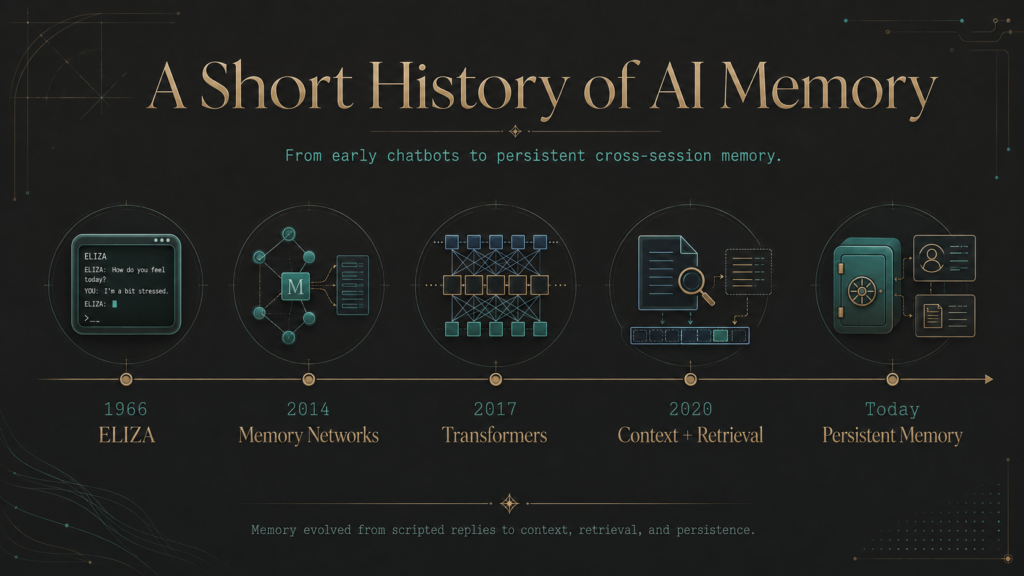
AI did not begin by remembering.
For most of the history of computing, a conversation with a machine was exactly what it appeared to be in that moment: an exchange with almost no durable sense of what had come before. The system might respond to your previous sentence, but once the interaction ended, very little — often nothing — carried forward.
Today, that feels strange. We increasingly expect an AI to remember preferences, instructions, documents, previous conversations and even patterns in the way we work.
That expectation is relatively new.
The history of AI memory is really the history of several different technologies gradually being mistaken for one thing: context, learned knowledge, retrieval and persistent memory.
They are not the same.
The earliest chatbots remembered almost nothing
In 1966, Joseph Weizenbaum published ELIZA, one of the earliest programs capable of producing the impression of a natural-language conversation.
ELIZA could analyze text and transform parts of a user’s input into a response. Its most famous script simulated a Rogerian psychotherapist, often turning statements back into questions.
The effect could be surprisingly convincing.
But ELIZA did not remember a person in the way we now expect an AI assistant to remember someone. Its behavior was driven largely by rules, patterns and transformations applied during the interaction. It had no persistent personal memory that accumulated across conversations.
This established a pattern that would last for decades:
A system could appear conversational without possessing anything like human memory.
The illusion of continuity was easier to create than continuity itself.
Memory became an explicit research problem
By the 2010s, researchers were increasingly building systems that needed to do more than respond to the latest input.
Question answering, reasoning and longer interactions required information to remain available while a task unfolded.
In 2014, researchers Jason Weston, Sumit Chopra and Antoine Bordes introduced Memory Networks — models that combined inference with a long-term memory component that could be read from and written to.
The important shift was conceptual.
Memory was no longer merely an accidental result of processing a sequence. It could be treated as an explicit component of an intelligent system: something information could enter, something the model could search, and something it could use when generating an answer.
That idea would reappear in many forms.
But the next major breakthrough would make AI appear far more capable of remembering even when no durable memory existed at all.
The Transformer changed what remembering looked like
In 2017, the paper Attention Is All You Need introduced the Transformer architecture.
Instead of processing language primarily through recurrent neural networks, the Transformer used attention mechanisms that allowed different parts of an input sequence to interact directly.
That architecture became the foundation for the modern large language model.
And it created something that feels remarkably similar to memory during a conversation.
A model can look back across the information currently available to it and use relevant earlier details when producing the next token.
But this is an important distinction:
Attention is not persistent memory.
The model can work with information that exists inside its active input, but that information does not automatically become a durable record that survives indefinitely.
What users often experience as “the AI remembering” is actually the model using its current context.
Large language models made context feel like memory
The effect became much more obvious as language models grew.
GPT-3, described in 2020, demonstrated powerful in-context learning: examples and instructions could be supplied directly in the prompt, and the model could use them without changing its underlying parameters.
The information existed temporarily in the model’s working context.
This changed how people interacted with AI.
Instead of issuing isolated commands, users could build conversations.
A fact mentioned earlier could influence an answer later.
An instruction could continue shaping subsequent responses.
A few examples could teach the model the format of a task.
For the user, this could feel like memory.
Technically, however, it was still constrained by the context window — the finite amount of information available to the model at one time.
That distinction matters enough that we covered it separately in What “Context Window” Actually Means.
A larger working space gives an AI more information to work with. It does not automatically give the system permanent memory.
Retrieval added an external kind of memory
Another important development arrived in parallel.
Instead of requiring all useful knowledge to exist inside the model’s parameters or current conversation, systems could retrieve information from an external source when needed.
The 2020 paper introducing Retrieval-Augmented Generation, or RAG, described a system combining a language model’s parametric knowledge with a non-parametric external memory — in that case, a searchable collection of documents.
The system could retrieve relevant material and provide it to the model before generating an answer.
This created another thing that looks like memory.
Ask a system about a document stored months ago and it may retrieve the document and answer correctly.
Did the model remember it?
Not necessarily.
It may simply have found it again.
That distinction — storage versus retrieval versus recall — is central to understanding modern AI memory.
Long context made the illusion stronger
As context windows became larger, AI systems could process increasingly long conversations and documents.
That made continuity dramatically better.
A model that can see much more of a conversation has more opportunities to recover an earlier instruction or detail.
But capacity and recall are different properties.
A piece of information may technically still exist somewhere inside a long context without reliably influencing the model’s answer when it matters.
This is why saying that a model “supports” a certain amount of context does not fully describe its memory behavior.
The better questions are:
How much information survives effectively?
What gets retrieved?
What gets ignored?
What happens when old and new information conflict?
And:
Does recall degrade as the conversation becomes longer?
Those are behavioral questions rather than specification-sheet questions.
Persistent memory changed the product
The next major shift happened when AI products began carrying information from one conversation into another.
Now the interaction no longer had to start completely from zero.
In 2024, OpenAI publicly introduced memory controls for ChatGPT, including saved memories and the ability to reference information from previous conversations. The important change was not simply a larger context window: selected information could persist beyond the conversation in which it first appeared.
This is much closer to what most people intuitively mean when they say an AI remembers them.
A preference mentioned today might affect an answer next week.
A recurring project might no longer require a complete explanation every time.
The system begins to develop continuity across sessions.
But persistent memory creates a new set of problems.
What should be remembered?
For how long?
What should be forgotten?
How does the system decide which memory is relevant?
What happens when a memory becomes outdated?
And can the user reliably inspect and correct what the system believes it remembers?
Memory stops being only a capability problem.
It becomes a retrieval, control and trust problem.
AI memory is now a stack
There is no single mechanism called “AI memory.”
Modern systems can combine several layers:
Parametric knowledge — information learned during training and encoded in the model’s parameters.
Context — information temporarily available during the current interaction.
Retrieval — information located in an external document store, database or knowledge system when needed.
Persistent memory — information deliberately carried across conversations or sessions.
Application state — information stored by the software surrounding the model, such as tasks, preferences, files or user profiles.
From the outside, all of these can produce the same experience:
The AI remembered.
Inside the system, however, very different processes may have produced that answer.
That difference matters because each layer fails differently.
Context can overflow.
Retrieval can choose the wrong document.
Stored memory can become outdated.
Training knowledge can be stale.
A system can store something correctly and still fail to retrieve it.
The history of AI memory is moving from storage to reliability
For decades, the challenge was simply giving machines access to useful information.
Now the harder problem is deciding what survives and whether the right information returns at the right moment.
An AI that stores everything but retrieves poorly does not have useful memory.
An AI that remembers an instruction but forgets when it should stop applying it can be worse than one that forgets entirely.
And an AI that confidently reconstructs a missing detail may appear to remember something it never retained at all.
So the next stage of AI memory will not be defined only by larger context windows or bigger databases.
It will be defined by reliable retention, retrieval, correction and forgetting.
That is the transition worth watching.
AINeverForget exists to track it — across models, updates and time.